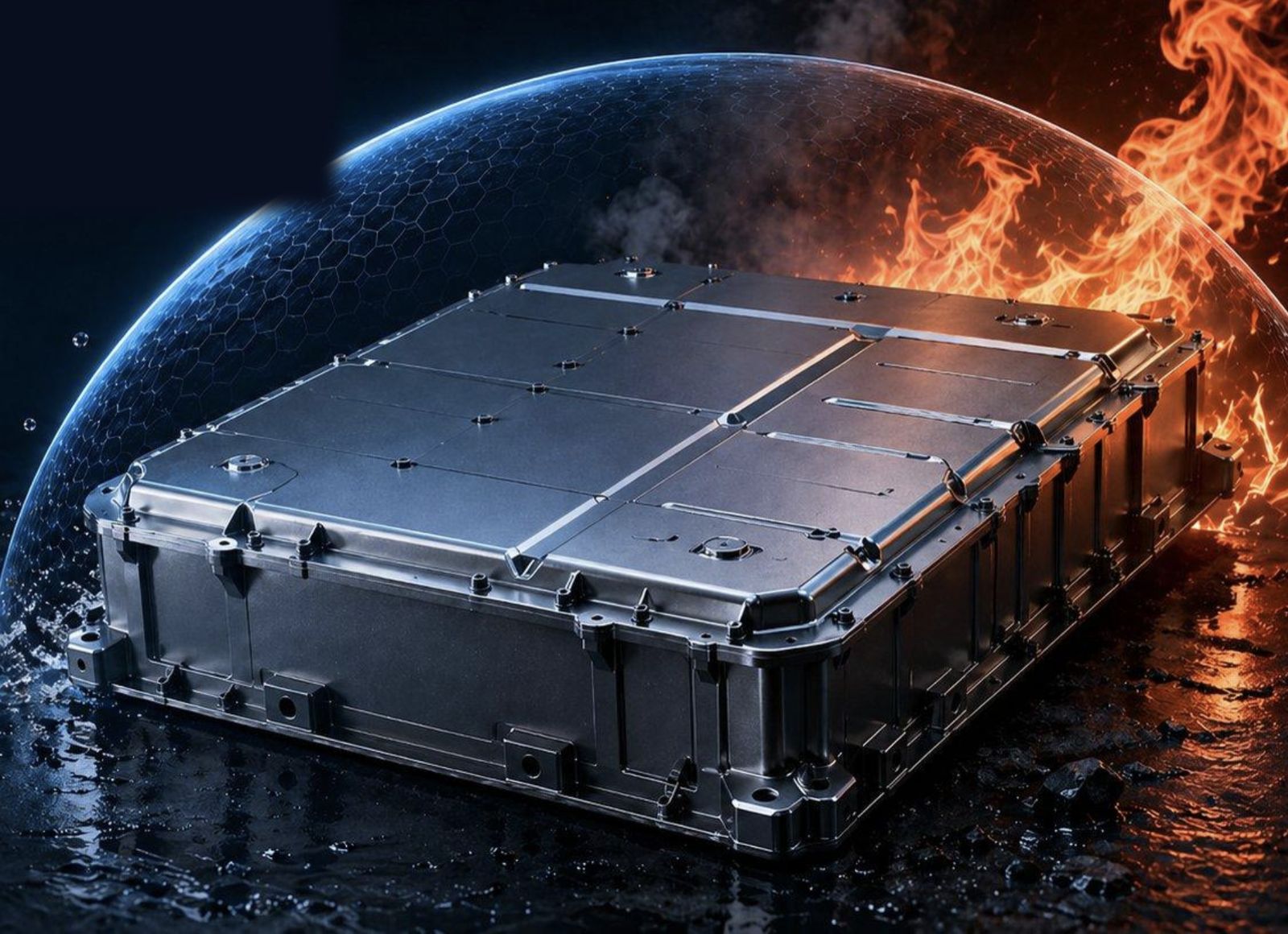
GEOMET® 730 EV

Non-flammable zinc flake coating for EV battery cases

Saving
Lives.

When a battery cell goes into thermal runaway, the case has to hold the fire long enough for everyone to get out. GEOMET® 730 EV forms Ceramic Armor from 1,200 °C and does not ignite even at 1,500 °C and above.

  • 1,500 °C+No ignition at extreme heat
  • 5 minTorch & grit test passed
  • 1,200 hSalt spray, no red rust

From Corrosion Protection to EV Battery Safety

GEOMET® 730 EV is a zinc–aluminum–silicon flake coating developed for the upper and lower cases of EV battery systems. It protects the metal against corrosion for the life of the vehicle, and in a thermal runaway it becomes a ceramic barrier between the fire and the passengers. One thin coating replaces a stack of paint and insulation sheets, and it is already in series production.

First application at Hyundai Motor Group

Genesis GV90

The Genesis GV90 is the first Hyundai Motor Group vehicle to protect its battery case with GEOMET® 730 EV. Under the cabin floor, the case is the barrier between the cells and the people.

Battery case

  • Ceramic ArmorNo ignition even at 1,500 °C
  • Passive ShieldProtects where the case is damaged
  • Improved real-world durabilityChipping resistance

Illustration.

WE CAN.

Create value through GEOMET® 730 EV

Saving Lives

Ceramic Armor

From about 1,200 °C, the zinc, aluminum and nano-silicon in the coating react and form ceramic phases whose melting points reach 1,500–1,900 °C. Even at 1,500 °C and above, the coating does not ignite. Seven alternative solutions failed the OEM's five-minute torch & grit requirement. GEOMET® 730 EV passed.

How Ceramic Armor works
Durability

Passive Shield

Battery cases get chipped, scratched and bolted. After stone chips, abrasion, cross-cuts and fastening damage, E-coat showed red rust. GEOMET® 730 EV did not, because the zinc around the damage reacts and seals it.

See the damage tests
Sustainability

Carbon & Cost Reduction

No conversion coating, no mica sheet on top, low-temperature curing and a thin film. Each removed layer and step saves energy, CO₂ and cost on every part.

Where the savings come from
Future Growth

Multi-Substrate

GA steel today, GI steel and aluminum as well. New platforms move the aluminum cooling plate to the top, where it becomes the upper case. There, a single thin 1C1B coat stops crevice and pitting corrosion in the channels. As battery structures change, one coating follows the design.

See the aluminum story

Proven against OEM battery case requirements

TestRequirementGEOMET® 730 EV
Torch & gritNo ignition, 5 minPass
Film thickness≥ 6 µmPass · 13–14 µm
AdhesionCross-hatch M1.0–M2.5Pass
Impact resistanceDuPont 500 g · 20 cm, no cracking or peelingPass
Water resistance40 °C · 480 h, cross-hatch M1.0–M2.5Pass
Salt spray (SST)1,200 h, no red rustPass
CCT-A40 cycles, no red rustPass
CCT-C56 cycles, loss ≤ 10%Pass
CCT-F20 cycles, loss ≤ 10%Pass

Requirements include the battery case items planned for the next OEM specification revision.

  • 2026In series production on EV battery cases
  • 17EV programs specified
  • 5Regions in the NOF Metal Coatings network

Beyond anti-corrosion

Saving Lives.

Driving a safer EV era with GEOMET® 730 EV

For NOF Metal Coatings Group members Playbook, production lines, technical data and documents. Password required.